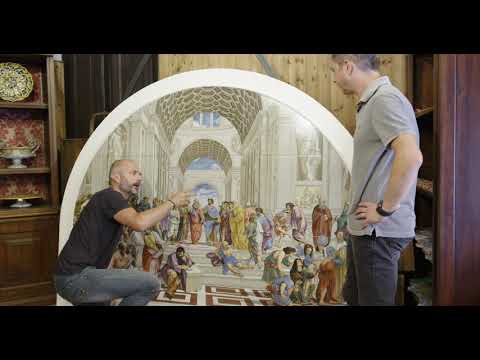
Gilberto Galavotti and Giuliano Smacchia graduated in 1987 from the State Art Institute of Urbino; Giuliano also later graduated from the Academy of Fine Arts in set design. At the "Cipriano Piccolpasso" Center of Don Leonardi, they began to learn the technique of majolica thanks to masters like Vittorio Salvatori and Orazio Bindelli. For some time they produced as students, reaching excellent levels; in early 1995 they opened their shop, at the most significant moment of the ceramic revival in Urbania.
Gilberto and Giuliano are the "twins" of ceramics: together they research forms, ancient decorations, and glazes; together they work on large artifacts, and together they lead their workshop, which has become a small museum. The classical period of Casteldurante and Urbino is their hallmark: they produce historiated pieces, Raphael-style decorations, vases, and large flasks.

 In the 16th century, along with Urbino and Pesaro, Casteldurante
produced some of the most beautiful majolica of the Renaissance. At that time, over 40 kilns
were
active in the town for Italian and European commissions, and Durantine masters often left their
homeland to spread their art. Cipriano Piccolpasso of Casteldurante wrote "The Three Books of
the
Potter's Art" in 1548, outlining the rules and secrets of ceramic making.
In the 16th century, along with Urbino and Pesaro, Casteldurante
produced some of the most beautiful majolica of the Renaissance. At that time, over 40 kilns
were
active in the town for Italian and European commissions, and Durantine masters often left their
homeland to spread their art. Cipriano Piccolpasso of Casteldurante wrote "The Three Books of
the
Potter's Art" in 1548, outlining the rules and secrets of ceramic making.In 1636, Casteldurante became Urbania; in the 17th and 18th centuries, talented sculptors and
painters continued the glorious tradition, renewing the art with the "elegance of shapes and the
gentleness of the paste."
Today in Urbania, the extraordinary richness and colors of historiated vases and plates live on
in
the new workshops.
In 1994, Urbania was recognized as a "production area for artistic and traditional ceramics" by the AICC (Italian Association of Ceramic Cities), being the first municipality in the Marche region (Law 188/'90).
Durantine ceramics were exhibited in 1996 at the European Parliament in Strasbourg, in 1997 at the Leipzig Tourism Fair (Germany), in 2007 in Prague, and are still present in important art galleries and the most famous national and international tourism and culture fairs.
Mon-Fri: 9:00am → 5:30pm
Sat: 10:00am → 2:30pm
Sunday: Closed
L'Antica Casteldurante snc di Smacchia & Galavotti
Piazza Camillo Benso Conte di Cavour, 4
61049 Urbania (PU) - Italy
For information, orders and availability, contact us directly via phone or email.